I’ve finished the low fat chapter! I don't think I made the most effective use of this chapter (remember August? Sheesh!). It's a bit outdated to be eating low fat food these days anyway - recent buzzwords include "Low GI" and "low carb". But there are some lovely noodle recipes in here, and the stews are generally pretty good too.
Here are the recipes.
98. Braised Fennel
103. Cauliflower and Cumin
94. Vegetables with Ginger and Garlic
Quick Stuff, or Suggestions for Almost-Thrown-Together Suppers
75. Steak
99. Poisson au Poivre
354. Tataki of Tuna
93. Sugar Spiced Salmon with Chinese Hot Mustard
83. Brown Rice Salad
73. Aromatic Chilli Beef Noodle Soup
87. Mushroom Udon Soup
74. Braised Dried Shitake Mushrooms with Soba Noodles
84. Seaweed and Noodle Salad
76. Mackerel Teriyaki
82. Salmon Marinated in Den Miso
104. Cambodian Hot and Sour Beef Salad
310. Thai-Flavoured Mussels
342. Thai Clam Pot
89. Vegetable Miso Broth
18. Lacquered Quail
19. Japanese Flavoured Sweet-Sour Cabbage
97. Beet Greens and Buckwheat Noodles
95. Shredded Beetroot Salad with Yogurt
105. Beetroot Soup
85. Restrained Mushroom Risotto
107. Fine Pasta with Crab
Salad Dressings
185. Miso Mustard Dressing
13. Dijon Mustard Dressing
116. Thick Miso Dressing for Beans
86. Thick Roast Garlic and Lemon Dressing
Cook and Freeze-Ahead
77. Vegetable Curry in Vegetable Sauce
88. Beef Braised in Beer
106. Half-Coq au Vin
364. Char Siu 1
365. Char Siu 2
I can’t find the link for the “roast garlic and lemon dressing”, but I know I’ve made it, as I’ve crossed it off my list. (It’s not in my index – I checked). Anyway, if anyone knows where it is, please let me know!
Showing posts with label Low Fat. Show all posts
Showing posts with label Low Fat. Show all posts
Sunday, May 28, 2006
Wednesday, May 24, 2006
Hot Jewish Potato Pancakes
Here is what Mum and I had for lunch today.
374. Char Siu 1
375. Char Siu 2
376. Latkes (Basics etc.)
Nigella has 2 recipes for char siu (AKA glazed roast pork loin, Chinese style) in the Low Fat chapter. She suggests making up char siu in advance, slicing it, and stashing it in the freezer to use when you want to add some meat to your low-fat supper. (e.g. soup noodles etc). I made both char siu marinades last night, and let the pork loins marinate overnight.
The first marinade contains:
- soy sauce
- tomato ketchup
- hoisin sauce
- sweet sherry
- honey
- dark muscovado sugar
I had all these ingredients in my pantry.
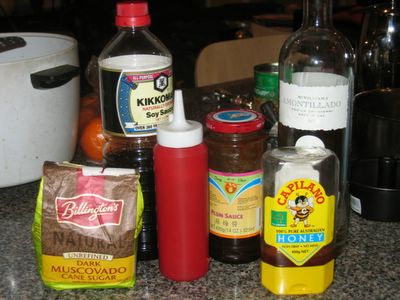
Marinade ingredients (1)
The 2nd marinade seems to just be made up of random shit that Nigella had lying around her fridge. It contains:
- soy sauce
- prune juice
- mushroom ketchup (huh??)
- miso
- mirin
- sesame oil
- garlic
- light muscovado sugar
I used regular ketchup instead of mushroom ketchup, and coca cola for prune juice (it was a long shot, but I just wanted something sweet. And hey, it worked for the ham).
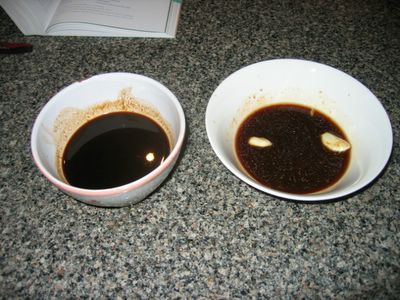
char siu marinade (1 on the left, 2 on the right)
Today, I put the loins in the oven (200C for 15 minutes, then 160C for 30 minutes), and got on with the latkes. I do realize the total inappropriateness of having latkes (i.e. a hot Jewish potato pancake) with roast pork… but I just really, really need to get through these recipes right now. Besides, a latke is a “hot Jewish potato pancake” – there is nothing I don’t like about that description. How could I resist?
So to make latkes, you need to grate up a few potatoes (using a processor, natch)…
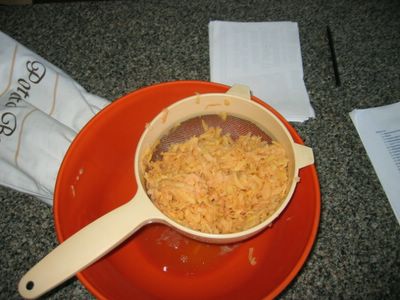
grated potato
...then drain the potato pieces, and mix them with some chopped onion, flour (or matzah meal), egg and salt.
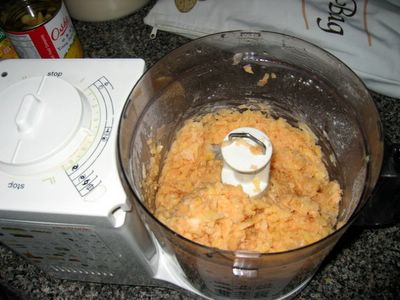
Then you just gotta fry the pancakes in hot oil for about 5 minutes a side. I love frying food, it is just so much fun.
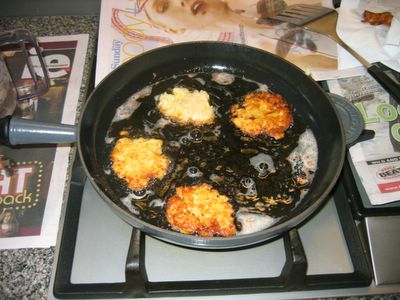
I believe I can fry
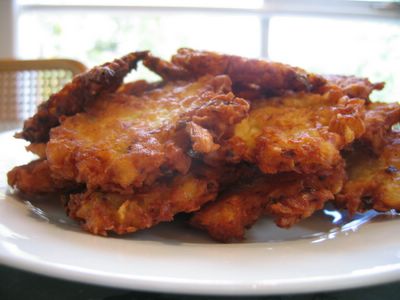
Latkes!!
Here’s the char siu. Both marinades were pretty decent, even the weird one with the coke in it. I wouldn’t ever use them as a substitute for the real, red-glazed, deliciously greasy char siu that you find in Hong Kong BBQ shops, but for the purpose they were intended (addition of protein to low-fat meals), they are fine.
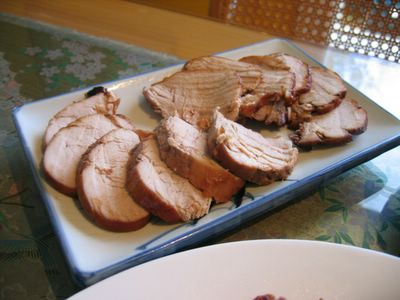
char siu
Ooh, but those latkes! They’re fantastic! So crispy and oily and totally compulsive.
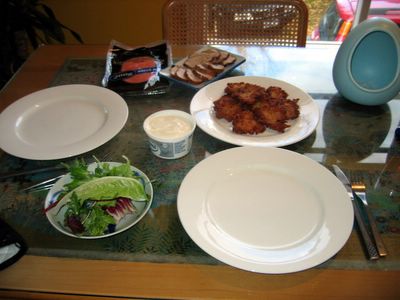
Lunch
They’re good plain, but I also served the latkes with cream cheese and smoked salmon, which was brilliant. Cream cheese + fried potato and onion = the same flavour combo as in sour cream and onion flavoured chips. In other words, I was in flavour country. It’s a big country.

smoked salmon on latkes
Check it out, I folded the smoked salmon pieces just like I used to at my old job at the buffet restaurant. Man, I remember having to fold hundreds of pieces of salmon a night, and arranging them on huge expensive glass platters to feed the greedy greedy crowds. It was such a crap job.
But onto dessert - the lemon balm and Sauternes jelly which I made last night. After lunch, I unmoulded the jelly, and ate it with my mum. We drowned it in cream, and it was lovely. Very refreshing and light. However, it was unexpectedly alcoholic, which is why I think it didn’t set very hard. Maybe next time I’ll use more sugar syrup and less alcohol. Either way, it tasted good.
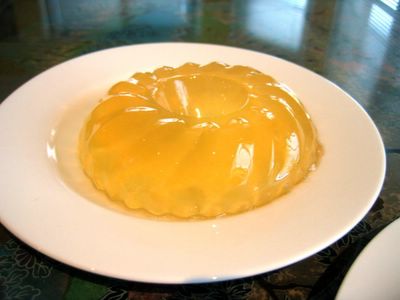
sauternes and lemon balm jelly
374. Char Siu 1
375. Char Siu 2
376. Latkes (Basics etc.)
Nigella has 2 recipes for char siu (AKA glazed roast pork loin, Chinese style) in the Low Fat chapter. She suggests making up char siu in advance, slicing it, and stashing it in the freezer to use when you want to add some meat to your low-fat supper. (e.g. soup noodles etc). I made both char siu marinades last night, and let the pork loins marinate overnight.
The first marinade contains:
- soy sauce
- tomato ketchup
- hoisin sauce
- sweet sherry
- honey
- dark muscovado sugar
I had all these ingredients in my pantry.

Marinade ingredients (1)
The 2nd marinade seems to just be made up of random shit that Nigella had lying around her fridge. It contains:
- soy sauce
- prune juice
- mushroom ketchup (huh??)
- miso
- mirin
- sesame oil
- garlic
- light muscovado sugar
I used regular ketchup instead of mushroom ketchup, and coca cola for prune juice (it was a long shot, but I just wanted something sweet. And hey, it worked for the ham).
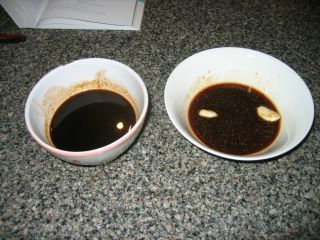
char siu marinade (1 on the left, 2 on the right)
Today, I put the loins in the oven (200C for 15 minutes, then 160C for 30 minutes), and got on with the latkes. I do realize the total inappropriateness of having latkes (i.e. a hot Jewish potato pancake) with roast pork… but I just really, really need to get through these recipes right now. Besides, a latke is a “hot Jewish potato pancake” – there is nothing I don’t like about that description. How could I resist?
So to make latkes, you need to grate up a few potatoes (using a processor, natch)…
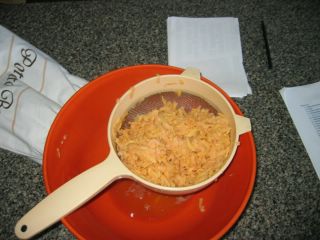
grated potato
...then drain the potato pieces, and mix them with some chopped onion, flour (or matzah meal), egg and salt.

Then you just gotta fry the pancakes in hot oil for about 5 minutes a side. I love frying food, it is just so much fun.

I believe I can fry
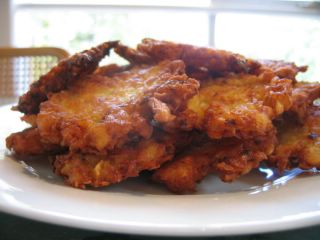
Latkes!!
Here’s the char siu. Both marinades were pretty decent, even the weird one with the coke in it. I wouldn’t ever use them as a substitute for the real, red-glazed, deliciously greasy char siu that you find in Hong Kong BBQ shops, but for the purpose they were intended (addition of protein to low-fat meals), they are fine.
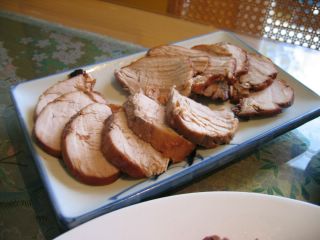
char siu
Ooh, but those latkes! They’re fantastic! So crispy and oily and totally compulsive.

Lunch
They’re good plain, but I also served the latkes with cream cheese and smoked salmon, which was brilliant. Cream cheese + fried potato and onion = the same flavour combo as in sour cream and onion flavoured chips. In other words, I was in flavour country. It’s a big country.
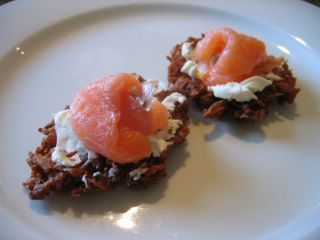
smoked salmon on latkes
Check it out, I folded the smoked salmon pieces just like I used to at my old job at the buffet restaurant. Man, I remember having to fold hundreds of pieces of salmon a night, and arranging them on huge expensive glass platters to feed the greedy greedy crowds. It was such a crap job.
But onto dessert - the lemon balm and Sauternes jelly which I made last night. After lunch, I unmoulded the jelly, and ate it with my mum. We drowned it in cream, and it was lovely. Very refreshing and light. However, it was unexpectedly alcoholic, which is why I think it didn’t set very hard. Maybe next time I’ll use more sugar syrup and less alcohol. Either way, it tasted good.
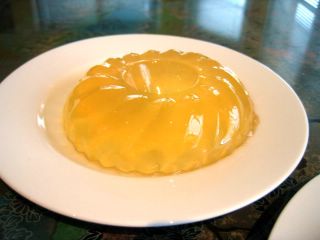
sauternes and lemon balm jelly
Saturday, May 20, 2006
Pig’s bum and tuna
For lunch today, we had a lovely low-fat griddled tuna dish. Followed by a steamed pudding with lashings of custard. Ooh yeah.
364. Tataki of Tuna (Low Fat)
365. Quick Foolproof Custard (Basics etc)
I chose to reprise the pig's bum because I needed a pudding to go with the second custard recipe in the Basics etc. chapter, and I seem to have already completed all the other puddings and crumbles. The pig's bum is without a doubt my favourite pudding from the whole book.
Just in case you forgot…
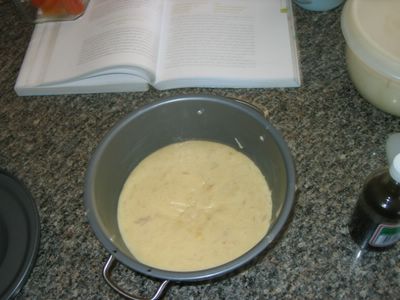
The mixture for this steamed sponge is equal parts butter, sugar and flour, with 2 eggs, some baking powder, vanilla extract and milk (so just a normal sponge-cake mixture), with a rhubarb puree mixed through. And apart from the cooking of the rhubarb (which takes a scant 5 minutes), it’s all done in the processor.
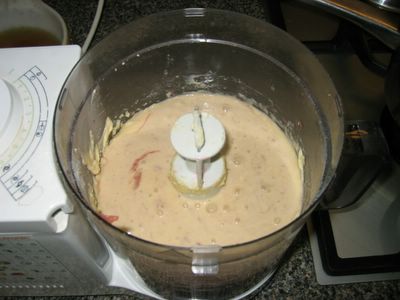
pig's bum mixture
pudding in basin
Steamer
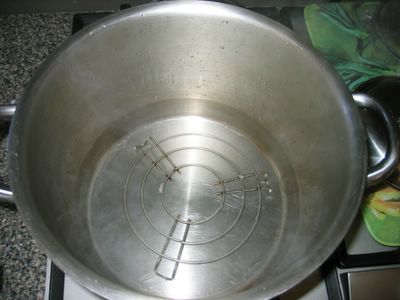
You have to put the lid on the pudding basin, and let it steam for 2.5 hours. And in the meantime, I made the custard.
The quick foolproof custard is good for the custard-o-phobes among us (aah.. I remember when I used to be one of them!) because it dispenses with that whole nerve-wracking “stirring over low heat” stage. What you do is whisk some egg yolks, sugar and cornflour in a bowl. In a pan, you heat cream with a vanilla pod, and “allow the cream to rise in the pan”, before pouring it over the eggs, and whisking for a good 10 minutes until thick. I had no idea what allowing “the cream to rise in the pan” meant, so I just let it bubble a teensy weensy bit before adding it to the eggs. The custard took about 10 minutes with a KitchenAid mixer on medium heat.
Upon reflection, I don’t know why I didn’t try this custard back in the days when I couldn’t make custard, as it would have saved a lot of bother. But in the end, I guess it’s good that I forced myself to learn how to make custard with old fashioned stirring. Because even though this custard tasted fab, it did have a lot of tiny little air bubbles in it from the whisking, so it didn’t have that lovely voluptuous gloop of real custard.
Nigella says to have cold custard with the pudding, so I set the custard aside while I made the main.
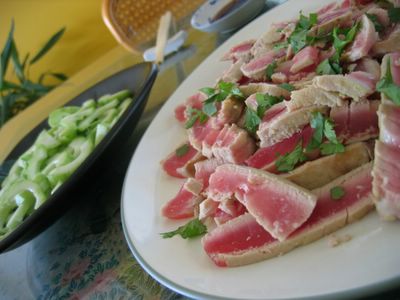
Tataki of tuna is ideally, a long round tail piece of tuna, seared on all sides, and sliced thinly. I had to substitute tuna steaks, as they were all I could find, but the result was still good. I dusted the sides with wasabi powder, and cooked them briefly on a high heat in a cast-iron frypan.
Nigella says to serve with thin slivers of spring onions and a sprinkling of coriander, as well as a side salad of cucumber slices. As for sauces, she suggests a paste made of wasabi powder mixed with soy, or a mixture of soy, sugar and lime juice. I made both, just to try each one.
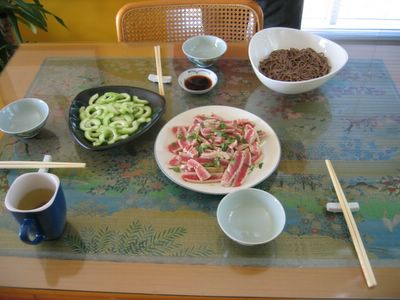
I also served it with cold soba noodles, dressed with a mixture of all the Japanesey sauces from my pantry – mirin, soy, rice vinegar, and honey.
tuna and cucumber salad
Table
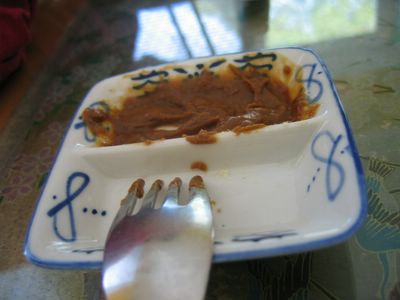
wasabi powder mixed with soy
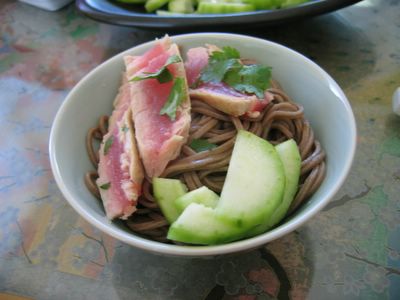
one bowl
It was a fabulous lunch. The noodles, the tuna, the cucumber, the sauces – all lovely. After plowing through so much of the rich, meat-and-potato heavy food that Nigella favours, this was a refreshing contrast. Goodness, how I love soba noodles! It was so healthy and delicious, and not in that resignedly virtuous way – it actually tasted good, irrespective of its being low-fat.
Mmm… now check out the dessert. I think words are superfluous in this instance; just check out the photos…
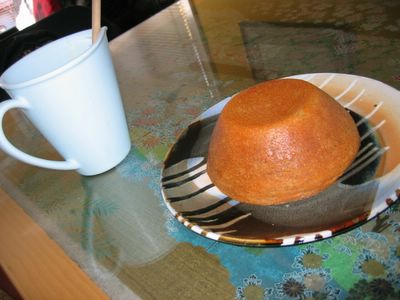
Pudding
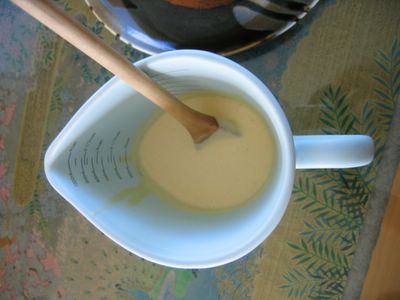
Custard
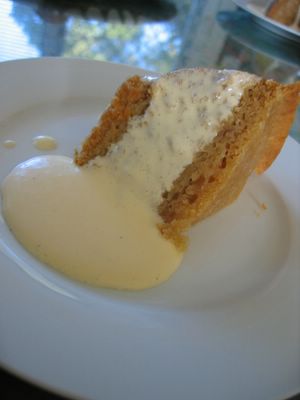
one delicious plate
Pig’s bum is totally the best.
364. Tataki of Tuna (Low Fat)
365. Quick Foolproof Custard (Basics etc)
I chose to reprise the pig's bum because I needed a pudding to go with the second custard recipe in the Basics etc. chapter, and I seem to have already completed all the other puddings and crumbles. The pig's bum is without a doubt my favourite pudding from the whole book.
Just in case you forgot…
The mixture for this steamed sponge is equal parts butter, sugar and flour, with 2 eggs, some baking powder, vanilla extract and milk (so just a normal sponge-cake mixture), with a rhubarb puree mixed through. And apart from the cooking of the rhubarb (which takes a scant 5 minutes), it’s all done in the processor.

pig's bum mixture

pudding in basin
Steamer
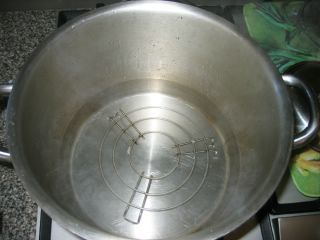
You have to put the lid on the pudding basin, and let it steam for 2.5 hours. And in the meantime, I made the custard.
The quick foolproof custard is good for the custard-o-phobes among us (aah.. I remember when I used to be one of them!) because it dispenses with that whole nerve-wracking “stirring over low heat” stage. What you do is whisk some egg yolks, sugar and cornflour in a bowl. In a pan, you heat cream with a vanilla pod, and “allow the cream to rise in the pan”, before pouring it over the eggs, and whisking for a good 10 minutes until thick. I had no idea what allowing “the cream to rise in the pan” meant, so I just let it bubble a teensy weensy bit before adding it to the eggs. The custard took about 10 minutes with a KitchenAid mixer on medium heat.
Upon reflection, I don’t know why I didn’t try this custard back in the days when I couldn’t make custard, as it would have saved a lot of bother. But in the end, I guess it’s good that I forced myself to learn how to make custard with old fashioned stirring. Because even though this custard tasted fab, it did have a lot of tiny little air bubbles in it from the whisking, so it didn’t have that lovely voluptuous gloop of real custard.
Nigella says to have cold custard with the pudding, so I set the custard aside while I made the main.
Tataki of tuna is ideally, a long round tail piece of tuna, seared on all sides, and sliced thinly. I had to substitute tuna steaks, as they were all I could find, but the result was still good. I dusted the sides with wasabi powder, and cooked them briefly on a high heat in a cast-iron frypan.
Nigella says to serve with thin slivers of spring onions and a sprinkling of coriander, as well as a side salad of cucumber slices. As for sauces, she suggests a paste made of wasabi powder mixed with soy, or a mixture of soy, sugar and lime juice. I made both, just to try each one.
I also served it with cold soba noodles, dressed with a mixture of all the Japanesey sauces from my pantry – mirin, soy, rice vinegar, and honey.
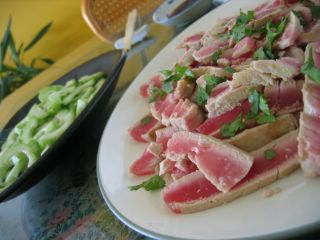
tuna and cucumber salad

Table

wasabi powder mixed with soy
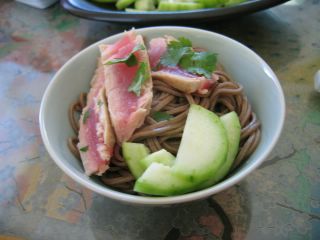
one bowl
It was a fabulous lunch. The noodles, the tuna, the cucumber, the sauces – all lovely. After plowing through so much of the rich, meat-and-potato heavy food that Nigella favours, this was a refreshing contrast. Goodness, how I love soba noodles! It was so healthy and delicious, and not in that resignedly virtuous way – it actually tasted good, irrespective of its being low-fat.
Mmm… now check out the dessert. I think words are superfluous in this instance; just check out the photos…
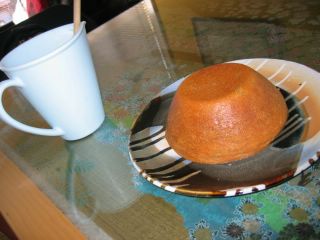
Pudding

Custard

one delicious plate
Pig’s bum is totally the best.
Sunday, April 23, 2006
Thai Clam Pot
342. Thai Clam Pot (Low Fat)
Clams are surprisingly difficult to find. On Saturday morning, I asked Dad to take me to Prahran Market (the only place where you can ALWAYS find clams). However, he thought it was too far, and said we'd be able to find clams in Kew or on Victoria Parade (the Vietnamese district), both of which are much closer.
Well, there were no clams in Kew. (But on the upside, I did buy the most fabulous egg and bacon baguette at the wonderful Convent Bakery on High street. The baker also gave us a free loaf of light rye and a latté. Sweet!)

egg & bacon baguette (emphatically NOT low fat)
We then headed to Victoria Parade, and started looking at their fishmongers. There were mussels, crabs, pippies, all sorts of fish... but no freaking clams! It was only at the third fishmongers we visited that we found clams. I didn't think looked like clams, but Dad assured me these were clams - the kind that he used to eat growing up in Malaysia. And seeing as I was making an Asian dish, I thought they'd be appropriate.
So I took them home, and soaked them, then drained them, ready to use.
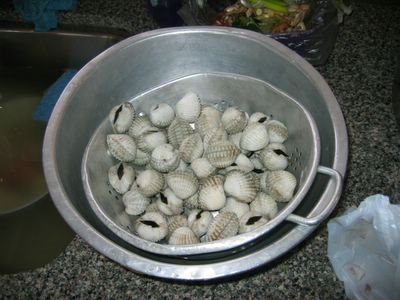
asian clams
This dish is pretty straightforward. Cook noodles in boiling water and set aside. Then heat through garlic, spring onion and dried chilli in a little oil, before adding sake and water, allowing it to boil and then chuck in the clams. I'm used to cooking clams until they open, so I hovered near the stove, watching the boiling liquid, waiting for the clams to open. 5 minutes passed, and not a single one opened. Shit. I got more and more nervous, until Dad came in and told me, "They're not supposed to open, don't overcook them!". Whoops. I guess I'm just not used to handling Asian clams.
So I quickly finished off the dish by taking the clams off the heat and adding fish sauce and coriander, and tossing the whole lot together.
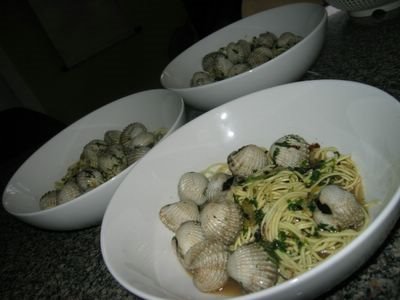
thai clam pot
It was very tasty, although opening each clam individually proved to be a bit annoying. (This is ok if you're eating a big bowl of chilli clams with no accompaniment, but not when you're eating them with noodles.) Next time I make this dish, I'm sticking to ordinary vongole clams!
Clams are surprisingly difficult to find. On Saturday morning, I asked Dad to take me to Prahran Market (the only place where you can ALWAYS find clams). However, he thought it was too far, and said we'd be able to find clams in Kew or on Victoria Parade (the Vietnamese district), both of which are much closer.
Well, there were no clams in Kew. (But on the upside, I did buy the most fabulous egg and bacon baguette at the wonderful Convent Bakery on High street. The baker also gave us a free loaf of light rye and a latté. Sweet!)

egg & bacon baguette (emphatically NOT low fat)
We then headed to Victoria Parade, and started looking at their fishmongers. There were mussels, crabs, pippies, all sorts of fish... but no freaking clams! It was only at the third fishmongers we visited that we found clams. I didn't think looked like clams, but Dad assured me these were clams - the kind that he used to eat growing up in Malaysia. And seeing as I was making an Asian dish, I thought they'd be appropriate.
So I took them home, and soaked them, then drained them, ready to use.

asian clams
This dish is pretty straightforward. Cook noodles in boiling water and set aside. Then heat through garlic, spring onion and dried chilli in a little oil, before adding sake and water, allowing it to boil and then chuck in the clams. I'm used to cooking clams until they open, so I hovered near the stove, watching the boiling liquid, waiting for the clams to open. 5 minutes passed, and not a single one opened. Shit. I got more and more nervous, until Dad came in and told me, "They're not supposed to open, don't overcook them!". Whoops. I guess I'm just not used to handling Asian clams.
So I quickly finished off the dish by taking the clams off the heat and adding fish sauce and coriander, and tossing the whole lot together.
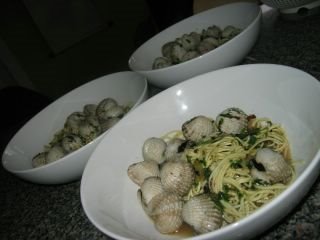
thai clam pot
It was very tasty, although opening each clam individually proved to be a bit annoying. (This is ok if you're eating a big bowl of chilli clams with no accompaniment, but not when you're eating them with noodles.) Next time I make this dish, I'm sticking to ordinary vongole clams!
Friday, March 24, 2006
Mmm... I love eating mussels!
Mussels fall into that category of "things Sarah tries to avoid cooking". This may seem bizarre, as I love to eat mussels, and they're not that hard to cook. But the thing is, really, really fresh mussels aren't easy to come by. At Box Hill they can be pretty hit or miss, and I never really feel like driving all the way to Prahran or Fitzroy just for mussels. But when I went to Box Hill this morning, the mussels I saw there this morning looked good, so I was in business.
310. Thai-Flavoured Mussels (Low Fat)
This dish took a grand total of 10 minutes to make. The first stage is to finely chop up some Thai-style flavourings - garlic, ginger, lemongrass, kaffir lime leaves - and cook them in stock until soft. I used dashi, but Nigella says you can use anything you like. Then you add finely chopped chillies, then the mussels themselves. Finally, you pour over a mixture of boiled water, lime juice, mirin and fish sauce, and let it cook until the mussels are steamed open. To serve, you throw in some chopped coriander.
It smelled absolutely heavenly! Before the How to Eat project, my cooking repertoire relied heavily on mod-pan-Asian flavours, which were so popular throughout the early years of this decade. Since starting the project, I've not been eating this type of food so much. I've missed it!
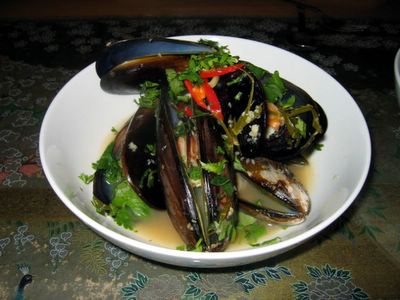

Just one note - Nigella's recipe feeds one, and I doubled it to feed my mum and I tonight. This wasn't nearly enough! I don't think you need more mussels, but adding vegetable or noodles would really help, especially considering how fragrant and strong the broth was.
But overall, this tasted absolutely lovely! And to think, there's no added fat in the dish at all. Great stuff.
310. Thai-Flavoured Mussels (Low Fat)
This dish took a grand total of 10 minutes to make. The first stage is to finely chop up some Thai-style flavourings - garlic, ginger, lemongrass, kaffir lime leaves - and cook them in stock until soft. I used dashi, but Nigella says you can use anything you like. Then you add finely chopped chillies, then the mussels themselves. Finally, you pour over a mixture of boiled water, lime juice, mirin and fish sauce, and let it cook until the mussels are steamed open. To serve, you throw in some chopped coriander.
It smelled absolutely heavenly! Before the How to Eat project, my cooking repertoire relied heavily on mod-pan-Asian flavours, which were so popular throughout the early years of this decade. Since starting the project, I've not been eating this type of food so much. I've missed it!

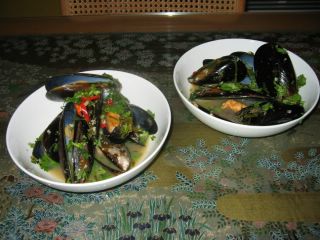
Just one note - Nigella's recipe feeds one, and I doubled it to feed my mum and I tonight. This wasn't nearly enough! I don't think you need more mussels, but adding vegetable or noodles would really help, especially considering how fragrant and strong the broth was.
But overall, this tasted absolutely lovely! And to think, there's no added fat in the dish at all. Great stuff.
Saturday, December 03, 2005
Do you ever have one of those days at work where everything just goes wrong?
Yesterday afternoon, I was on the bus, about a quarter of the way to work, when I realised that I’d left my keys (including the crucial locker key, without which I would be unable to retrieve my uniform) in my friend George’s car. So I got off the bus, and called my Dad, who very generously picked me up and drove me to George’s house to get my key, and thence to the closest tram stop. After all this, I was half an hour late to work. Luckily my manager, Ben, is a top bloke and very understanding. However, because of my lateness, I was basically thrown head-first into successive sold-out sessions of Harry Potter and the Goblet of Fire, and spent my whole shift feeling very lost, running drinks into the cinemas, up and down stairs with heavy trays of glasses. For some reason I was really klutzy too, and kept spilling drinks and knocking shit over – glasses of water, champagne, beer etc. At one particularly low point of the evening, I spilled two glasses of champagne down my top. My uniform is black, thank goodness, but I still smelled like an alcoholic for the rest of the evening. I finished work at 11:30pm, determined to come straight home and sleep, to prepare for my next shift, which started at 11:00am the next morning.
Soon after I came home, however, my friend Liam popped over to say hi. Liam, my brother and myself stayed up watching Ricky Jervais’ Politics on DVD. Fucking brilliant. It was so funny that I barely even noticed the time, and suddenly it was 3:30am! I was a bit worried about how I'd handle the next day. However, the next morning, I woke up on time, went to work, and had an excellent shift, with everything running smoothly and no dramas at all. I was in kitchen, not waitering, which basically meant that I just cooked all the orders as they came in, and made OTHER PEOPLE run them into the cinemas and deal with the customers. It was a great shift, but needless to say I was rather buggered when I got home at 7:00pm, just in time to make dinner.
That might have been a long-winded way to start this post, but the point was (and trust me, there is a point) to illustrate how wonderful and easy tonight’s dinner was.
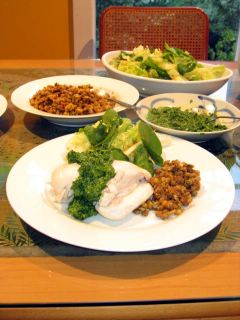
184. Chicken with Salsa Verde (Fast Food)
185. Miso Mustard Dressing (Low Fat)
The chicken is chicken breasts, poached for about 10 minutes in some stock (cubes with water), with parsley stalks, bay leaves and a chopped carrot (I had no celery). While that was going on, I made some lentils, cooked as per another suggestion in the Fast Food chapter. That is to say you firstly cook a finely chopped mixture of onion, garlic, carrot and parsley in some oil, tip in the lentils and then warm them through. I’ve tried this many times before with other pulses, and it’s a great accompaniment.
I also made a salad dressing from the Low Fat chapter – miso, wholegrain mustard, honey and orange juice to go with baby spinach and cos lettuce.
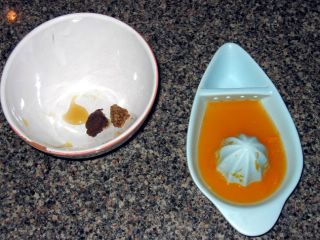
Dressing
And then the salsa verde. This just involves bunging everything into a processor and turning it on.
Then all I had to do was put the food on plates, and a lovely, healthy and nourishing dinner for my mother and I was served.
Soon after I came home, however, my friend Liam popped over to say hi. Liam, my brother and myself stayed up watching Ricky Jervais’ Politics on DVD. Fucking brilliant. It was so funny that I barely even noticed the time, and suddenly it was 3:30am! I was a bit worried about how I'd handle the next day. However, the next morning, I woke up on time, went to work, and had an excellent shift, with everything running smoothly and no dramas at all. I was in kitchen, not waitering, which basically meant that I just cooked all the orders as they came in, and made OTHER PEOPLE run them into the cinemas and deal with the customers. It was a great shift, but needless to say I was rather buggered when I got home at 7:00pm, just in time to make dinner.
That might have been a long-winded way to start this post, but the point was (and trust me, there is a point) to illustrate how wonderful and easy tonight’s dinner was.
184. Chicken with Salsa Verde (Fast Food)
185. Miso Mustard Dressing (Low Fat)
The chicken is chicken breasts, poached for about 10 minutes in some stock (cubes with water), with parsley stalks, bay leaves and a chopped carrot (I had no celery). While that was going on, I made some lentils, cooked as per another suggestion in the Fast Food chapter. That is to say you firstly cook a finely chopped mixture of onion, garlic, carrot and parsley in some oil, tip in the lentils and then warm them through. I’ve tried this many times before with other pulses, and it’s a great accompaniment.
I also made a salad dressing from the Low Fat chapter – miso, wholegrain mustard, honey and orange juice to go with baby spinach and cos lettuce.
Dressing
And then the salsa verde. This just involves bunging everything into a processor and turning it on.
Then all I had to do was put the food on plates, and a lovely, healthy and nourishing dinner for my mother and I was served.
Thursday, September 08, 2005
A not quite quick after-work supper for three
I was working today from 10:00am til 5:00pm, and taking the bus, arrived home around 6:00 o'clock. I had planned a dinner of grilled chicken breasts, wilted spinach and tinned pulses with dressing, which I thought would be a quick, simple and effort free dinner. How wrong I was!
115. Chicken with Lemon/Oil/Garlic (Fast Food)
116. Thick Miso Dressing for Beans (Low Fat)
117. Warm Spinach with Lemon (Dinner)
First problem - the chicken breasts weren't defrosted. Acutally, this was the only problem. But it screwed everything else up. I'd asked my mum to take them out of the freezer during the day, but come dinner time they were still rock solid. Waah! So I started defrosted them in the microwave, which took a fucking age. I did them in 10 minute bursts, and even after 30 minutes, they were starting to go dry and white on the edges, whilst remaining solid within. By this stage, I was getting closer and closer to tears. (Dramatic, yes. But I was tired dammit, tired!!) It took a lot of gentle prodding and pulling and pushing and microwaving to get them defrosted and unfolded and ready for the grill.
Anyway, when I finally got them turned in their oil lemon and garlic marinade, and onto the grill, I started on the side dishes. Seeing as the spinach needs to be at room temperature, I did it first. The spinach recipe comes from the Dinner chapter, and is the suggested accompaniment for a Fillet of Beef with Red Wine, Anchovies, Garlic and Thyme. It's just wilted in a pan with some butter and oil, and sprinkled with lemon or sumac (I chose sumac) before serving. Fantastic stuff.
For the thick miso dressing for beans, you mix together some miso paste, rice vinegar and sesame oil and then stir it through your beans of choice. I used a tin each of chick peas, borlotti beans and cannellini beans, and warmed them in a wok with the dressing.
So, in the end, dinner was on the table by about 7:30 and tears were averted.
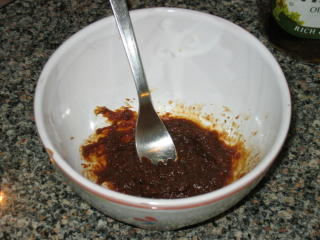 Miso dressing
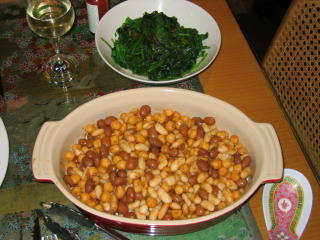 Spinach in the background, beans in the foreground
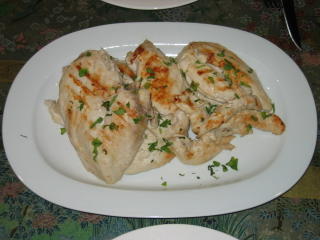 Chicken with lemon/oil/garlic
The chicken is plain, but tasty. Spinach is always a winner, especially with sour flavourings. And the beans, the beans!! Miso (fermented soy bean paste) is such a wonderful way to add flavour without adding fat. It's definitely being repeated.
Dad: Wow, we'll be farting tonight.
Er, thanks Dad!
115. Chicken with Lemon/Oil/Garlic (Fast Food)
116. Thick Miso Dressing for Beans (Low Fat)
117. Warm Spinach with Lemon (Dinner)
First problem - the chicken breasts weren't defrosted. Acutally, this was the only problem. But it screwed everything else up. I'd asked my mum to take them out of the freezer during the day, but come dinner time they were still rock solid. Waah! So I started defrosted them in the microwave, which took a fucking age. I did them in 10 minute bursts, and even after 30 minutes, they were starting to go dry and white on the edges, whilst remaining solid within. By this stage, I was getting closer and closer to tears. (Dramatic, yes. But I was tired dammit, tired!!) It took a lot of gentle prodding and pulling and pushing and microwaving to get them defrosted and unfolded and ready for the grill.
Anyway, when I finally got them turned in their oil lemon and garlic marinade, and onto the grill, I started on the side dishes. Seeing as the spinach needs to be at room temperature, I did it first. The spinach recipe comes from the Dinner chapter, and is the suggested accompaniment for a Fillet of Beef with Red Wine, Anchovies, Garlic and Thyme. It's just wilted in a pan with some butter and oil, and sprinkled with lemon or sumac (I chose sumac) before serving. Fantastic stuff.
For the thick miso dressing for beans, you mix together some miso paste, rice vinegar and sesame oil and then stir it through your beans of choice. I used a tin each of chick peas, borlotti beans and cannellini beans, and warmed them in a wok with the dressing.
So, in the end, dinner was on the table by about 7:30 and tears were averted.
 Miso dressing
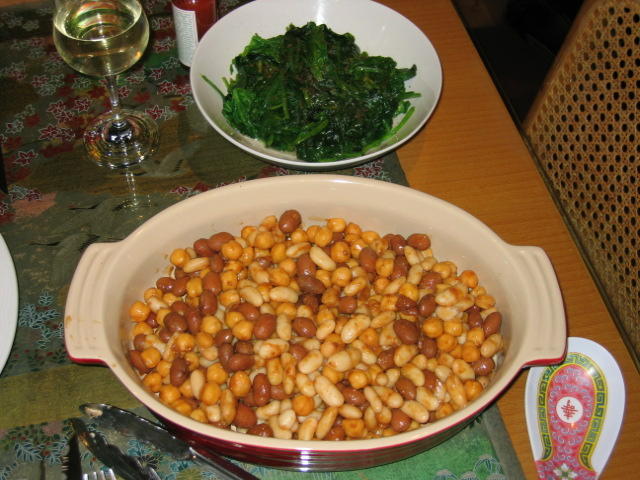 Spinach in the background, beans in the foreground
 Chicken with lemon/oil/garlic
The chicken is plain, but tasty. Spinach is always a winner, especially with sour flavourings. And the beans, the beans!! Miso (fermented soy bean paste) is such a wonderful way to add flavour without adding fat. It's definitely being repeated.
Dad: Wow, we'll be farting tonight.
Er, thanks Dad!
Wednesday, August 31, 2005
Last-ditch attempt at a low fat lunch
I'm wagging uni today because of my migraine of two nights ago. I'm petrified of getting another one, so I'm trying not to over-exert myself. I've been short on sleep recently, and I have a very busy week ahead of me - lots of assignments and tests, as well as a massive ball tomorrow night (ticket already paid for, make-up and hair already booked), a friend's 21st this Saturday night, and I had work last night and tonight. I need to rest up as best I can, and the only activity I could cut down on was class today. I'm staying home, studying, cooking and taking it easy, before going to work tonight.
Also, in the spirit of relaxation, going to the gym is out of the question. Theoretically, I should also avoid caffiene, but we all know that's not going to happen.
"Finally!", I hear you cry, "she's back in the kitchen." Here's what I made for lunch today...
107. Fine Pasta with Crab
I've made this pasta once before, before I started the How to Eat project. I wasn't super-keen on it at the time, (I found it dry and too boozey, even for me). However, I firmly believe that everything deserves a second chance. And besides, I had to make it for this project.
I used tinned crabmeat for this - I know, how horrendous - but I always use tinned, simply because getting fresh (or even frozen) crabmeat involves a drive all the way across town, and I just can not be arsed unless fresh meat is absolutely vital to the dish.
This is an Asian flavoured sauce, with garlic, chilli, coriander, lime and spring onions, simmered in wine and stirred through the pasta and crab meat. In the recipe, Nigella says to simmer the brown meat with the wine and aromatics, before adding the white meat at the end, but I would avoid simmering the meat unless it's fresh - it turns dry and feral otherwise, which is what happened last time I made this. Ooh, one more thing, I'd advise using less wine than she stipulates, (I used the remnants of a bottle in the fridge, which ended up being about half, and made up the volume with water). This prevents a too-intense inhalation of alcohol when eating.
It was heaps better this time. I'd definitely be making it again, and soon! As a bonus, in making this I used up loads of the herbs that were perilously close to dying in my fridge. It's a bit fiddly to make (lots of chopping), but not difficult. It's similar in a way, to Nigella's Linguine with Chilli, Crab and Watercress from Forever Summer, which I've made countless times and is one of my absolute favourites. This is a good, low-fat alternative to that one, but no less delicious for it.
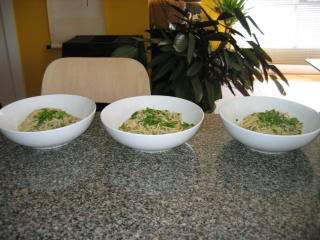
Low-fat, delicious, simple, elegant enough to share, but casual enough to eat in front of the TV. All boxes ticked!
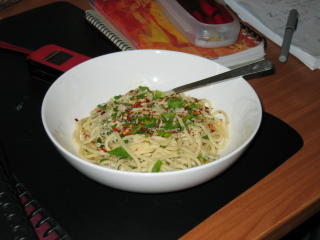
Dredge with dried chilli flakes for absolute perfection!
Also, in the spirit of relaxation, going to the gym is out of the question. Theoretically, I should also avoid caffiene, but we all know that's not going to happen.
"Finally!", I hear you cry, "she's back in the kitchen." Here's what I made for lunch today...
107. Fine Pasta with Crab
I've made this pasta once before, before I started the How to Eat project. I wasn't super-keen on it at the time, (I found it dry and too boozey, even for me). However, I firmly believe that everything deserves a second chance. And besides, I had to make it for this project.
I used tinned crabmeat for this - I know, how horrendous - but I always use tinned, simply because getting fresh (or even frozen) crabmeat involves a drive all the way across town, and I just can not be arsed unless fresh meat is absolutely vital to the dish.
This is an Asian flavoured sauce, with garlic, chilli, coriander, lime and spring onions, simmered in wine and stirred through the pasta and crab meat. In the recipe, Nigella says to simmer the brown meat with the wine and aromatics, before adding the white meat at the end, but I would avoid simmering the meat unless it's fresh - it turns dry and feral otherwise, which is what happened last time I made this. Ooh, one more thing, I'd advise using less wine than she stipulates, (I used the remnants of a bottle in the fridge, which ended up being about half, and made up the volume with water). This prevents a too-intense inhalation of alcohol when eating.
It was heaps better this time. I'd definitely be making it again, and soon! As a bonus, in making this I used up loads of the herbs that were perilously close to dying in my fridge. It's a bit fiddly to make (lots of chopping), but not difficult. It's similar in a way, to Nigella's Linguine with Chilli, Crab and Watercress from Forever Summer, which I've made countless times and is one of my absolute favourites. This is a good, low-fat alternative to that one, but no less delicious for it.

Low-fat, delicious, simple, elegant enough to share, but casual enough to eat in front of the TV. All boxes ticked!

Dredge with dried chilli flakes for absolute perfection!
Wednesday, August 24, 2005
Purple Rain
I did a lot of cooking last night. I made a half coq-au-vin, some beetroot soup and chargrilled some oil-free red peppers for fatless future snacking. I was up ‘til 2 am last night, and was absolutely buggered today. Mind you, I didn’t study at all last night, I was just cooking. I… am an idiot.
105. Beetroot Soup
106. Half Coq-au-vin
Both the beetroot soup and the stew are designed to be made in advance, and reheated as desired. I actually just made these recipes for the sake of it, without any concrete idea as to when we’d eat them. But when I opened the stew pot and saw the purple shade, I just knew that we had to eat it as soon as possible, with the (also purple) beetroot soup I’d just made.
To make the beetroot soup, you have to boil some beetroot in lots of water for a couple of hours until tender, then drain them. Once they’ve cooled a bit, you then peel off the skins and blend them with Dijon mustard and balsamic vinegar, adding enough of the (now deep, deep red) cooking water to make it soupy. I had to add quite a bit of water to get a decent texture.
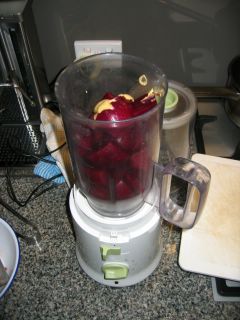
Beet soup in blender
The half coq-au-vin, (which I presume is called “half” because it’s reduced fat) is just an ordinary stew, and now that I’ve made a few stews, I’ve got into the swing of it. In general, it seems that you make stews by browning some meat, cooking up onions, carrots and/or celery, with herbs and spices, before re-adding the browned meat and some liquid. Then it’s just a matter of letting it cook slowly for an hour or more.
This one is actually very similar in flavour to the braised pheasant I made recently – they both contain red wine, bacon, onions, mushrooms and onions – but the half-coq au vin is heaps nicer! The liquid in question is a mixture of chicken stock and some reduced red wine (boiled up with various herbs), which gives an insanely purple shade to the chicken.
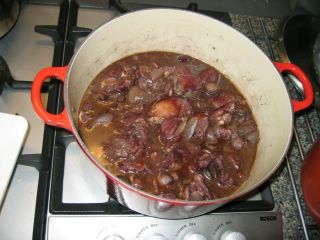
Purple Coq 1
Once it’s had its hour on the stove, Nigella says to heat some brandy in a ladle over a flame, let it ignite, and stir it into the stew. How fun! I love doing this kind of stuff. Once upon a time I would have found this step intimidating, but not anymore. I used to do this all the time at my old (crap) job, when I was a crepe flambeuse extraordinaire. I've left that job, but the pyromania hasn't left me.
And I’m not ashamed to admit (although perhaps I should be) that last night, when I opened the pot, the first words that popped out of my mouth were, “Oh my God! Look at that purple coq!”
This, of course, opened the floodgates for an onslaught of jokes. For example... today at uni with my mates…
“Hey, guess what I’m eating tonight!”
“Mmm… can’t wait to eat that purple coq.”
“I hope the coq tastes alright.”
… and so on. Well, I thought it was funny. And the stew gets more purple as it sits.
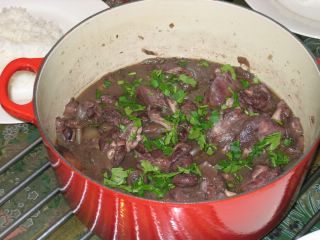
How purple!
So tonight when I came home, I didn’t really have to do any cooking at all. I just put some rice in the rice cooker, put the pots on the stove, and sat back to watch Knowing Me, Knowing You with Alan Partridge.
The stew was good – salty and winey and, as Nigella says, “proper and comforting and old-fashioned”.
We weren’t super-crazy about the soup. I thought it was alright, but not spectacular. It did have a smooth texture and nicely mild beetroot taste, but I think we just don’t like beetroot. There are three beetroot recipes in the Low Fat chapter, and none of them have been fab. They were ok, but they’re definitely on the list of must-repeat-soon-recipes.
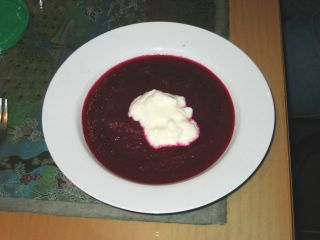
Beetroot soup - served with o% fat yogurt
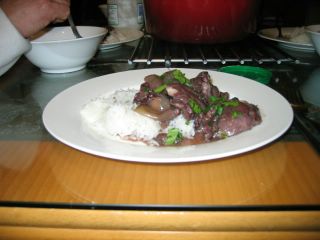
Coq on plate
105. Beetroot Soup
106. Half Coq-au-vin
Both the beetroot soup and the stew are designed to be made in advance, and reheated as desired. I actually just made these recipes for the sake of it, without any concrete idea as to when we’d eat them. But when I opened the stew pot and saw the purple shade, I just knew that we had to eat it as soon as possible, with the (also purple) beetroot soup I’d just made.
To make the beetroot soup, you have to boil some beetroot in lots of water for a couple of hours until tender, then drain them. Once they’ve cooled a bit, you then peel off the skins and blend them with Dijon mustard and balsamic vinegar, adding enough of the (now deep, deep red) cooking water to make it soupy. I had to add quite a bit of water to get a decent texture.
Beet soup in blender
The half coq-au-vin, (which I presume is called “half” because it’s reduced fat) is just an ordinary stew, and now that I’ve made a few stews, I’ve got into the swing of it. In general, it seems that you make stews by browning some meat, cooking up onions, carrots and/or celery, with herbs and spices, before re-adding the browned meat and some liquid. Then it’s just a matter of letting it cook slowly for an hour or more.
This one is actually very similar in flavour to the braised pheasant I made recently – they both contain red wine, bacon, onions, mushrooms and onions – but the half-coq au vin is heaps nicer! The liquid in question is a mixture of chicken stock and some reduced red wine (boiled up with various herbs), which gives an insanely purple shade to the chicken.
Purple Coq 1
Once it’s had its hour on the stove, Nigella says to heat some brandy in a ladle over a flame, let it ignite, and stir it into the stew. How fun! I love doing this kind of stuff. Once upon a time I would have found this step intimidating, but not anymore. I used to do this all the time at my old (crap) job, when I was a crepe flambeuse extraordinaire. I've left that job, but the pyromania hasn't left me.
And I’m not ashamed to admit (although perhaps I should be) that last night, when I opened the pot, the first words that popped out of my mouth were, “Oh my God! Look at that purple coq!”
This, of course, opened the floodgates for an onslaught of jokes. For example... today at uni with my mates…
“Hey, guess what I’m eating tonight!”
“Mmm… can’t wait to eat that purple coq.”
“I hope the coq tastes alright.”
… and so on. Well, I thought it was funny. And the stew gets more purple as it sits.
How purple!
So tonight when I came home, I didn’t really have to do any cooking at all. I just put some rice in the rice cooker, put the pots on the stove, and sat back to watch Knowing Me, Knowing You with Alan Partridge.
The stew was good – salty and winey and, as Nigella says, “proper and comforting and old-fashioned”.
We weren’t super-crazy about the soup. I thought it was alright, but not spectacular. It did have a smooth texture and nicely mild beetroot taste, but I think we just don’t like beetroot. There are three beetroot recipes in the Low Fat chapter, and none of them have been fab. They were ok, but they’re definitely on the list of must-repeat-soon-recipes.
Beetroot soup - served with o% fat yogurt
Coq on plate
Tuesday, August 23, 2005
Tuesday Night Dinner - Low carbohydrate, Low fat AND Nutritious
Perfect! Especially seeing as I needed to balance out the MSG-filled noodles I had for lunch at uni, and the Lindt milk chocolate I had in the afternoon. The chocolate came free with the latest issue of Delicious, and my logic dictates that if food is free, it can’t be bad for you! Hmmm… dubious. However, I did go to the gym today, and twice in the two days before that. So hopefully this will tip the scales in my favour, literally speaking.
103. Cauliflower with Cumin
104. Cambodian Hot and Sour Beef Salad
Nigella’s super-simple Cauliflower with Cumin is more of a suggestion than a recipe – all it takes is two ingredients, and twenty minutes in the oven. Like the braised fennel, this low-fat, highly flavoured way of preparing cauliflower is aimed at preventing the potentially repetitive boredom of a restricted diet. She says that “this is the best way to eat cauliflower, diet or no diet”, and having tasted it, in all its charred and spiced glory, I’m inclined to agree with her.
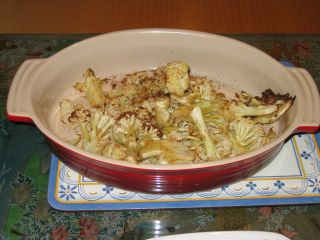
Cauliflower in Cumin
Now, for the salad.
Take one bowl of dressing…
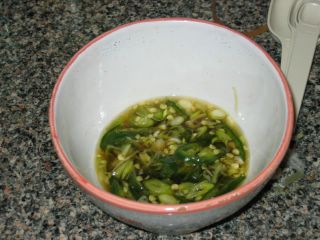
Dressing – fish sauce, lime juice, sugar, shallots and chillies
…and some grilled, thinly sliced steak…
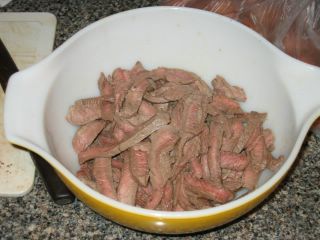
MEAT!
…mix through a packet of supermarket salad leaves…
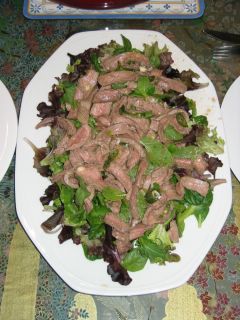
…and Bob’s your uncle!
This salad was absolutely ace! My dad had to keep putting his fork down to praise it. “This is great. Very delicious. Very tasty.”
103. Cauliflower with Cumin
104. Cambodian Hot and Sour Beef Salad
Nigella’s super-simple Cauliflower with Cumin is more of a suggestion than a recipe – all it takes is two ingredients, and twenty minutes in the oven. Like the braised fennel, this low-fat, highly flavoured way of preparing cauliflower is aimed at preventing the potentially repetitive boredom of a restricted diet. She says that “this is the best way to eat cauliflower, diet or no diet”, and having tasted it, in all its charred and spiced glory, I’m inclined to agree with her.
Cauliflower in Cumin
Now, for the salad.
Take one bowl of dressing…
Dressing – fish sauce, lime juice, sugar, shallots and chillies
…and some grilled, thinly sliced steak…
MEAT!
…mix through a packet of supermarket salad leaves…
…and Bob’s your uncle!
This salad was absolutely ace! My dad had to keep putting his fork down to praise it. “This is great. Very delicious. Very tasty.”
Friday, August 19, 2005
Paris via Tokyo
As we can see from all my recent posts, my Low-Fat August hasn't been quite as low fat as I'd originally intended. But what I'm trying to take from the Low Fat chapter is not just the recipes, but also the principles for making quick, delicious, low calorie meals. This way I'll have a good repertoire of healthy dishes which I can turn to for quick midweek lunches and dinners, when I don't feel like tackling a brand-new recipe, and don't want anything too rich or fattening. Otherwise it'd be stuff like creamy pastas, fried fishcakes, and toasted cheese sandwiches every other night. Lovely, but deadly for the waistline!
For instance, last night I did the mushroom udon soup again, and slurped it up hungrily whilst at the computer. Much better than a take-away pizza!
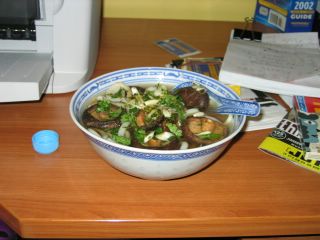
I'm also in the process of making, again, the beef braised in beer, and this time in double quantities. We loved it so much! I think it could only be a good thing to have a hearty, tasty, low-fat stew, individually portioned, frozen, and ready to go. I've also got some vegetable curry in vegetable sauce in the freezer. (Actually, stay tuned for photos of my bulging freezer...)
Keeping in mind Nigella's principles of low fat eating, here's what I made for dinner tonight.
98. Braised Fennel
99. Poisson au Poivre
One of the tricks to sticking to low-fat eating, apparently, is to include lots of variety so you don't get bored. We don't eat, or even like fennel in the normal run of things, (you should have seen the look on my parents' faces when I told them what we were going to eat - and I'm not hot for it either), but this was divine! The fennel in this dish is sliced thinly, and cooked with a bit of stock in the oven. And it was great - the thin slicing and long cooking made it soft and tender, without that feral, strong aniseed flavour that undercooked or raw fennel has. Even the parentals were impressed with this!
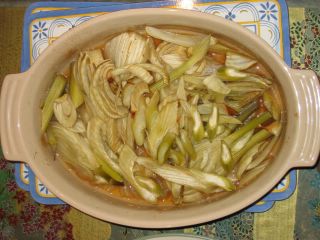
Braised Fennel
The poisson au poivre is "a juicy piscine take on the bifteck bistro original". You can use any of the meatier fish varieties (tuna, swordfish, marlin, mahi-mahi etc), and then press crushed black pepper on the sides (which I crushed myself in a pestle and mortar), before grilling on a non-oiled griddle. I used swordfish, because tuna was strangely unavailable anywhere today.
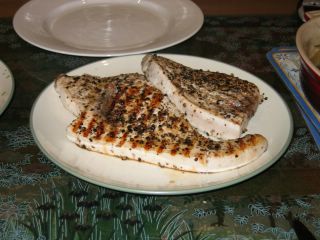
Poisson au Poivre
As a side dish, I chose to do soba noodles (hence the "Paris via Tokyo" title of this post). Obviously, Nigella's Low Fat chapter is awash with soba, as is my general diet, whether or not I want to lose weight. I cooked them, tossed them through some bottled sukiyaki sauce, and sprinkled coriander over. This was basically the tasty beet greens with buckwheat noodles but without the feral beet greens to ruin the noodles. Again, having noodles tonight was about variety - we'd typically eat plain steamed rice as a side dish.
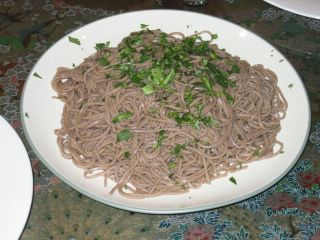
Soba noodles
This was a brilliant dinner. Bizzare cross-cultural mishmashes and connotations of tacky 80's fusion aside, the food was seriously good. The spicily hot fish contrasted well against the more subdued flavour of the noodles, as did the mildly-flavoured fennel. The meal overall was satisfyingly substantial, high in nutrients, low in fat and tasty. What more could you ask for?
For instance, last night I did the mushroom udon soup again, and slurped it up hungrily whilst at the computer. Much better than a take-away pizza!
I'm also in the process of making, again, the beef braised in beer, and this time in double quantities. We loved it so much! I think it could only be a good thing to have a hearty, tasty, low-fat stew, individually portioned, frozen, and ready to go. I've also got some vegetable curry in vegetable sauce in the freezer. (Actually, stay tuned for photos of my bulging freezer...)
Keeping in mind Nigella's principles of low fat eating, here's what I made for dinner tonight.
98. Braised Fennel
99. Poisson au Poivre
One of the tricks to sticking to low-fat eating, apparently, is to include lots of variety so you don't get bored. We don't eat, or even like fennel in the normal run of things, (you should have seen the look on my parents' faces when I told them what we were going to eat - and I'm not hot for it either), but this was divine! The fennel in this dish is sliced thinly, and cooked with a bit of stock in the oven. And it was great - the thin slicing and long cooking made it soft and tender, without that feral, strong aniseed flavour that undercooked or raw fennel has. Even the parentals were impressed with this!
Braised Fennel
The poisson au poivre is "a juicy piscine take on the bifteck bistro original". You can use any of the meatier fish varieties (tuna, swordfish, marlin, mahi-mahi etc), and then press crushed black pepper on the sides (which I crushed myself in a pestle and mortar), before grilling on a non-oiled griddle. I used swordfish, because tuna was strangely unavailable anywhere today.
Poisson au Poivre
As a side dish, I chose to do soba noodles (hence the "Paris via Tokyo" title of this post). Obviously, Nigella's Low Fat chapter is awash with soba, as is my general diet, whether or not I want to lose weight. I cooked them, tossed them through some bottled sukiyaki sauce, and sprinkled coriander over. This was basically the tasty beet greens with buckwheat noodles but without the feral beet greens to ruin the noodles. Again, having noodles tonight was about variety - we'd typically eat plain steamed rice as a side dish.
Soba noodles
This was a brilliant dinner. Bizzare cross-cultural mishmashes and connotations of tacky 80's fusion aside, the food was seriously good. The spicily hot fish contrasted well against the more subdued flavour of the noodles, as did the mildly-flavoured fennel. The meal overall was satisfyingly substantial, high in nutrients, low in fat and tasty. What more could you ask for?
Wednesday, August 17, 2005
Pink things
Tonight I tried yet another of Nigella’s three beetroot recipes from the Low Fat chapter. Given that we had a decent amount of last night’s shredded beetroot salad left over, we ate that as well. And seeing that both items were pink, I thought we should have a pink dessert as well (the rhubarb ice-cream that I made ten days ago). Who cares about the fat content? This meal was all about the aesthetic, and when it comes to bright colours, for me, too much is never enough.
97. Beet greens with buckwheat noodles
This dish is undemanding and stress-free – you cook up some chopped beet greens (which look just like rhubarb) in a pan, and toss in boiled soba noodles with bottled sukiyaki sauce. The noodles turn a fantastic shade of magenta.
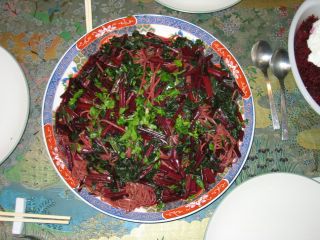
Beet greens with buckwheat noodles
We’d never tried beet greens before, and now that we have, I can’t say we’re mad about them. The leaves are ok, but the stems (even the little, thin ones) have this really weird salty taste and feral woodsy texture. In fact, we ended up just picking out all the noodles and leaving most of the beet greens on our plates.
Onto dessert – remember when I made the rhubarb ice-cream? I loved the mixture so much I had a good ten minutes of serious, concentrated licking – no bowl, utensil or beater was safe. But I think something went wrong in the churning process, as the final result was slightly icy. Tasty, but icily hard. Perhaps a 40 minute period of ripening in the fridge would have helped, but there was no way we were going to wait that long. I served it with some leftover chocolate sauce (from the recipe for Poires Belle Hélène), which I made to go with homemade vanilla ice-cream seven weeks ago. And just to let you know, it was still good. So if you ever make this chocolate sauce, and for some reason, don’t finish it immediately, an extended stint in the fridge will do it no harm at all.
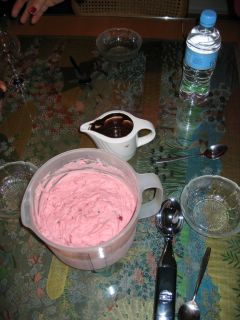
Ice cream
97. Beet greens with buckwheat noodles
This dish is undemanding and stress-free – you cook up some chopped beet greens (which look just like rhubarb) in a pan, and toss in boiled soba noodles with bottled sukiyaki sauce. The noodles turn a fantastic shade of magenta.
Beet greens with buckwheat noodles
We’d never tried beet greens before, and now that we have, I can’t say we’re mad about them. The leaves are ok, but the stems (even the little, thin ones) have this really weird salty taste and feral woodsy texture. In fact, we ended up just picking out all the noodles and leaving most of the beet greens on our plates.
Onto dessert – remember when I made the rhubarb ice-cream? I loved the mixture so much I had a good ten minutes of serious, concentrated licking – no bowl, utensil or beater was safe. But I think something went wrong in the churning process, as the final result was slightly icy. Tasty, but icily hard. Perhaps a 40 minute period of ripening in the fridge would have helped, but there was no way we were going to wait that long. I served it with some leftover chocolate sauce (from the recipe for Poires Belle Hélène), which I made to go with homemade vanilla ice-cream seven weeks ago. And just to let you know, it was still good. So if you ever make this chocolate sauce, and for some reason, don’t finish it immediately, an extended stint in the fridge will do it no harm at all.
Ice cream
Tuesday, August 16, 2005
Birds and Beets
I got the key items for tonight’s dinner from local merchants –the organic grocer around the corner supplied the beetroot, whilst Rendinas’ Butchery supplied the birds. They had no “poussin”, so I got the only other mini-birds they had, “spatchcocks”. I suspect they’re the same thing, actually. A poussin by any other name…
95. Shredded Beetroot Salad with Yogurt (Low Fat)
96. Roast Poussin with Garlic and Shallots (Feeding Babies and Small Children)
The star of this meal is the beetroot salad – Nigella suggests it to go with any roasted little bird, a recipe for which I found in the Feeding Babies and Small Children chapter. I adapted the recipe to be low-fat friendly by simply leaving out the oil and butter. Nigella includes a poussin recipe in the kids’ chapter, because she says they’re the perfect size for a child to eat by him or herself – this must mean that poussins are smaller than spatchcocks, or her children have large appetites. Either way, we were happy with the quantities!
This is a surprisingly elegant supper, given how simple it is to prepare. When I came home from yoga, I shoved the little spatchcocks in the oven with some unpeeled garlic and shallots. Whilst they were roasting, I did the salad. The salad is simply mint and coriander, chopped in a processor, mixed with peeled and grated beetroot (also done in the processor), and lemon juice. To serve, you place the large mound of beetroot on a plate, make a well in the centre and pour some fat-free yogurt in. Delicious. I wore rubber gloves to deal with the beetroot, so my hands were quite well protected from unsightly red stains. However, it was a different story for the benches, my utensils, the taps, the kitchen drawers…
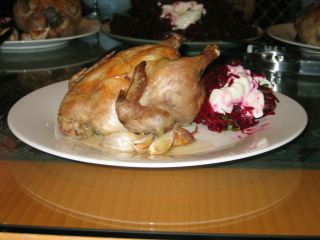
Roast Spatchcock with garlic and shallots, Beet salad on the side
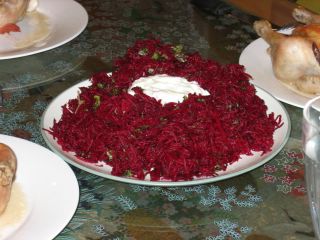
Shredded Beetroot Salad with Yogurt - what gorgeous, vibrant colours!
A note on quantities – I found that one 500 gram spatchcock per person was just right. The salad, on the other hand, makes an incredibly vast quantity (not necessarily a bad thing, I love its fresh and tangy crunchiness). The recipe says 725 grams of beet serves two people, with leftovers. I used about 800 grams, and the three of us only got halfway through it! Ah, the crazy quantities that exist in Nigella-land...
95. Shredded Beetroot Salad with Yogurt (Low Fat)
96. Roast Poussin with Garlic and Shallots (Feeding Babies and Small Children)
The star of this meal is the beetroot salad – Nigella suggests it to go with any roasted little bird, a recipe for which I found in the Feeding Babies and Small Children chapter. I adapted the recipe to be low-fat friendly by simply leaving out the oil and butter. Nigella includes a poussin recipe in the kids’ chapter, because she says they’re the perfect size for a child to eat by him or herself – this must mean that poussins are smaller than spatchcocks, or her children have large appetites. Either way, we were happy with the quantities!
This is a surprisingly elegant supper, given how simple it is to prepare. When I came home from yoga, I shoved the little spatchcocks in the oven with some unpeeled garlic and shallots. Whilst they were roasting, I did the salad. The salad is simply mint and coriander, chopped in a processor, mixed with peeled and grated beetroot (also done in the processor), and lemon juice. To serve, you place the large mound of beetroot on a plate, make a well in the centre and pour some fat-free yogurt in. Delicious. I wore rubber gloves to deal with the beetroot, so my hands were quite well protected from unsightly red stains. However, it was a different story for the benches, my utensils, the taps, the kitchen drawers…
Roast Spatchcock with garlic and shallots, Beet salad on the side
Shredded Beetroot Salad with Yogurt - what gorgeous, vibrant colours!
A note on quantities – I found that one 500 gram spatchcock per person was just right. The salad, on the other hand, makes an incredibly vast quantity (not necessarily a bad thing, I love its fresh and tangy crunchiness). The recipe says 725 grams of beet serves two people, with leftovers. I used about 800 grams, and the three of us only got halfway through it! Ah, the crazy quantities that exist in Nigella-land...
Monday, August 15, 2005
What does Nigella suggest for dinner?
Happy happy joy joy, today was the first day in about a week that I’ve actually had a proper low-fat day! The past week or so has seen a barrage of reasons (or excuses) to abandon my so-called period of restraint – my weekly allotted full-fat meal plus pudding; the need to use up the leftovers of said full-fat meal; going out too much; my inordinate passion for biscuits; an encounter with a platter of deep-fried cheese at a party (now really, that’s just cruel); a hangover or two; and… er… women’s troubles.
But today there was none of that – just an ordinary day full of delicious, light and nourishing food. Here’s what I ate today! (With apologies for coming over all Bridget Jones…)
Soy and linseed toast with vegemite and pear jam, 1 glass low-fat soy milk
1 skinny latté
1 Falafel salad roll
1 skinny latté, 1 banana
Dinner (see below)
Black tea with Seville orange juice, 1 apple
93. Sugar-Spiced Salmon with Chinese Hot Mustard
94. Vegetables with Ginger and Garlic
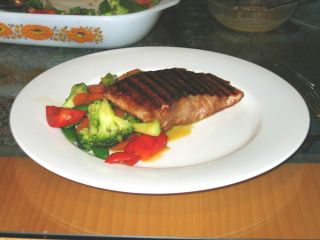
Sugar-Spiced Salmon with Chinese Hot Mustard and Vegetables
Both these recipes are suggestions from the beginning of the Low Fat chapter. The salmon comes from an American book called Pacifica Blue Plates by Neil Stuart, and gives an unusual taste and texture to a rather common fish. The salmon fillets are dredged in a mixture of spices (ginger, cinnamon, cumin, cayenne, mustard powder), sugar and salt, and grilled. The spice mixture forms a lovely crusty coating on the fish, and is sweet, salty and hot all at the same time. The “Chinese Hot Mustard” sauce is water, mustard powder and sugar. It tastes nice, and complements the salmon well, but I prefer the mustard sauce which accompanies the salmon in Nigella Bites’ Templefood chapter. (That one is mustard powder, water, ginger and soy sauce – and it’s lovely).
For the vegetables, it’s more the method than the exact ingredients that are important here. Nigella’s fat-free method of cooking vegetables is a mixture of stir-frying and steaming – heat some stock, ginger, garlic and spring onions in a wok before adding vegetables and stirring until cooked. Ransacking my fridge, I used carrots, broccoli (no bugs in it this time!), red capsicum, and sugar snap peas. This is a really fantastic, flavourful way to cook vegetables, retaining their nutrients, texture and colour. I highly recommend that you try it.
But today there was none of that – just an ordinary day full of delicious, light and nourishing food. Here’s what I ate today! (With apologies for coming over all Bridget Jones…)
Soy and linseed toast with vegemite and pear jam, 1 glass low-fat soy milk
1 skinny latté
1 Falafel salad roll
1 skinny latté, 1 banana
Dinner (see below)
Black tea with Seville orange juice, 1 apple
93. Sugar-Spiced Salmon with Chinese Hot Mustard
94. Vegetables with Ginger and Garlic
Sugar-Spiced Salmon with Chinese Hot Mustard and Vegetables
Both these recipes are suggestions from the beginning of the Low Fat chapter. The salmon comes from an American book called Pacifica Blue Plates by Neil Stuart, and gives an unusual taste and texture to a rather common fish. The salmon fillets are dredged in a mixture of spices (ginger, cinnamon, cumin, cayenne, mustard powder), sugar and salt, and grilled. The spice mixture forms a lovely crusty coating on the fish, and is sweet, salty and hot all at the same time. The “Chinese Hot Mustard” sauce is water, mustard powder and sugar. It tastes nice, and complements the salmon well, but I prefer the mustard sauce which accompanies the salmon in Nigella Bites’ Templefood chapter. (That one is mustard powder, water, ginger and soy sauce – and it’s lovely).
For the vegetables, it’s more the method than the exact ingredients that are important here. Nigella’s fat-free method of cooking vegetables is a mixture of stir-frying and steaming – heat some stock, ginger, garlic and spring onions in a wok before adding vegetables and stirring until cooked. Ransacking my fridge, I used carrots, broccoli (no bugs in it this time!), red capsicum, and sugar snap peas. This is a really fantastic, flavourful way to cook vegetables, retaining their nutrients, texture and colour. I highly recommend that you try it.
Subscribe to:
Posts (Atom)

